Showing posts with label Hope Street Group. Show all posts

Thursday, February 16, 2017

To Spouses: Thank You!


I’ve been a public school teacher since 2003, but I’ve known that I was going to be a teacher since 1992, when I was in the seventh grade. When I was in middle school, I had no idea what or where I would end up teaching, and I certainly had not heard of Manchester--the beautiful town that I am proud to call home.

It’s funny how life works out sometimes. I have ended up teaching high school English about an hour from where I grew up, and it’s fair to say that the notion of teaching public school crept into my soul 25 years ago, while sitting in a 7th grade math classroom in the heart of the projects near downtown Nashville, and consumed it.

I’ll be the first to admit that the all-consuming nature of following my passion of educating young people frequently creeps into the safe space where family life should exist. In honor of Valentine’s Day, I would like to thank my wife and my kids for being so incredibly understanding. My wife didn’t come from a family of teachers and, when she married me, I don’t think she knew at the time what she was getting herself into. For that matter, neither did I. Never would I have predicted all of the ups and downs and persistent changes that have happened in public education over the past decade or so. Never would I have predicted being able to sit across the table from the state’s Commissioner of Education, Dr. Candice McQueen, and discuss education policy with her--thanks to the Hope Street Group Tennessee teacher fellowship. Never would I have imagined being invited to a White House ceremony honoring some of America’s most distinguished teachers.

For the non-teachers out there--and especially to the teachers’ spouses--I want to explain something that is most difficult, even for an English teacher that typically employs vernacular with relative dexterity.

Teaching is difficult because it’s a never-ending job. I can literally never turn it off. I’m always looking for new and better ways of doing things (hence, the gradeless classroom that I operate). When I sit on the couch and watch a TV show, or when I’m listening to music in the car, in the back of my mind I’m always wondering how any of it can be effectively utilized in my classroom. Everything that I see and experience is fair game.

Teaching is difficult because Darwin’s evolutionary theory of “survival of the fittest” has never been truer than in public education today. I must adapt to and master changes to my standards, how students are tested, and how I am evaluated. This would be much easier if I had the same group of students year after year, but that’s mostly an impossibility. Accomplishing this feat with a brand new group of people that I literally just met and adapting to their interests and their needs requires an utmost attention to detail. Teachers must efficiently adapt to their environments, or quickly find themselves both ineffective and irrelevant. I must also help my colleagues fight off predators who wish to steal public education’s most valuable resource--money. This fight is frustratingly unending but entirely worth it because I love my students, and they need someone in their corner fighting for them.

When I come home exhausted in the afternoons, please understand that the source of the exhaustion (at least for me) is occasionally physical, but mostly mental. I literally make hundreds of crucial and not-so-crucial decisions every single day. Then, once I'm home, there’s the mental journey to prepare for the next day and do it all over again. Please forgive me when I sit in line at the fast food restaurant and take five minutes to decide what I want to eat. Sometimes, I'm just over making any more decisions.

Spouses, I want you to know that teachers need and deeply appreciate your support. We need you there to listen when we've had a frustrating day; we need your help around the house while we're evaluating papers and busy saving the world; sometimes, we need you help setting up our classrooms at the beginning of the year. No one else can support us like you can and, even though we don't always say it, from the bottom of our hearts, we thank you. I'm extremely lucky to have a wife who understands all this, and I especially want to thank you for being my rock.

Monday, September 19, 2016

Teaching Ghosts


One often overlooked aspect of the incessant testing and accountability culture that is so pervasive in today’s public education system is the fact that so many students are chronically absent from school. I have had several principals over the years (not my current one) who have told me that I can’t teach ghosts, and that I need to focus on the students sitting in front of me each day. There’s a certain amount of truth to that advice. It’s not healthy to worry about what I can’t control, and what I can control zaps almost all of the energy I have. Still, those students who are frequently absent and tardy to school will take the same TNReady test as the rest of my students, and if they don’t perform well (which is unlikely), they still count against my own evaluation as an educator and the school’s and district’s evaluations on the school report cards that are released each year.
The Tennessee Department of Education (TDOE) defines chronic absenteeism as a student who misses so much school--regardless of whether the absence is excused or unexcused--that the student is academically at risk of passing the school year. Usually, this means that the student has missed 10% or more of the instructional days, which would amount to at least 18 absences per school year. Discipline problems frequently accompany absenteeism because students are lost and bored when they return to school. TDOE is aware of this statewide problem and are working towards solutions.
Because of my role as a Hope Street Group (HSG) Teacher Fellow, I had the opportunity to participate in a webinar last week with TDOE on this very issue. Some of the information that was revealed during that webinar was interesting and eye-opening. While absentee rates vary greatly across the state, the largest absentee rates are at the two polar opposites of the educational spectrum--PreK and 12th grade, at 24% and 25%, respectively. African-Americans, students who are economically disadvantaged, and students with disabilities are the most likely groups of students who will miss school, at 17%. Across all grade levels, students who miss two or more days in August are five times as likely as their peers to be chronically absent. Ninth grade is a crucial year for students to attend school, as students in this grade level who are chronically absent are 38% less likely to graduate from high school.
Students miss school for a variety of reasons. Sometimes they have a strong aversion to school and don’t want to come because of: academically and social struggles, bullying, ineffective school discipline, negative school experience from the family, and undiagnosed disabilities. Other students are simply disengaged from a lack of engaging and relevant instruction, few meaningful relationships with adults in the school, and a poor school climate.
I would be remiss if I failed to mention that Coffee County Schools were highly praised by TDOE in the webinar. While many school systems saw their absentee rates increase last year, the opposite is true in Coffee County, where our attendance rates have increased. This is certainly something to be celebrated. September is “Attendance Awareness Month” in Tennessee, and each Coffee County School is doing something difference to bring students’ awareness to the importance of coming to school.
The recently passed Every Student Succeeds Act (ESSA), which replaces the federal No Child Left Behind Act, returns an extraordinary amount of power to states on how they want to operate their education systems. ESSA will go into effect next school year, and TDOE is working on how to eliminate obstacles to student success, like chronic absenteeism and student discipline. HSG is currently conducting in-person focus groups with teachers across the state on these two topics, and the results will be funneled to TDOE so they can make well-informed decisions based on teacher input. Running concurrently with the focus groups is HSG’s online survey, which will remain open until Friday, October 14th so that teachers can have their voices heard. The survey can be found at http://www.surveygizmo.com/s3/2982487/TNFall16.

Wednesday, September 14, 2016

Relationships Matter


I recently returned from a trip to Chicago where I attended the largest convening of Hope Street Group state teacher fellows ever assembled. Teachers from Tennessee, Kentucky, North Carolina, and Hawaii all assembled for two days so that we could share ideas on how to better collect and disseminate teacher voice in our respective states. Other than spending a couple of days with some of the most energizing solutions-oriented teachers in the country, one of the highlights of my trip was listening to our keynote speaker, Allan Blue.
Mr. Blue has a strong liberal arts background and majored in English and theater when he was in college. After teaching both of these subjects at the high school and community college levels for a number of years, he landed a job in the technology field quite by accident. A friend of his offered him a job as the creative director of a brand-new website called relationships.com. Haven't heard of it? That's okay, because neither has anyone else. It was a big flop. However, that experience led to his position of co-founding PayPal and, eventually, LinkedIn.
When asked about his advice for high school seniors, Blue suggested that they get work-like experience--meaning either job experience or volunteer work. He also advised that seniors should focus on how they can help others without expecting anything in return. Having a genuine interest in the success of others not only improves the fabric of society, but it is also an excellent way to learn how to be successful yourself. His final piece of advice for them is to learn how the workplace functions. After all, in order to move up the career ladder and experience the American Dream, it's crucial to see that the ladder exists, has rungs on it, and is waiting to be climbed.
Blue also discussed that what makes Silicon Valley successful is the underlying culture of innovation where people aren’t afraid to try new things and to fail. This is coupled with a constant blending of different companies, where people frequently leave one company to join another, share ideas with each other, and improve the newly-formed company. “Innovation happens,” he said, “when you put talent, opportunity, and a safe place to fail together.”
The fundamental theme of Allen Blue’s personal experiences and his advice to others is that relationships matter. He got his big break in the technology field because a friend observed his creativity and thought it could be channeled to help his internet business. As a result, Mr. Blue is now worth tens of millions of dollars.  His advice to high school seniors all centers around building relationships. Silicon Valley’s success is hinged upon people knowing and sharing ideas with each other with the common goal of continuous innovation.
The education field has much to learn from this. Teachers, school buildings, and even entire school systems notoriously function completely independent of each other. Case in point: Coffee County has three school districts and none of them collaborate with each other. They all share the common goal of educating the best that Coffee County has to offer; yet, the educators at each of these schools never share one in-service session and there’s no sharing of ideas, unless teachers reach out to each other on their own, which is a rare occurrence. The directors of these school systems have built relationships and are on friendly terms; it’s time for the same opportunity to be extended to teachers--at least, if Dr. McFall, Dr. Lawson, and Mr. Wilkerson are truly serious about providing the best opportunity for students to prosper. We are all part of Team Coffee County, and a lack of consolidation among the school systems should not prevent the unification of ideas and best practices.

Tuesday, June 21, 2016

All Means All


If you have a child enrolled in public schools, then he or she is in Response to Instruction and Intervention, or RTI2, whether you realize it or not. The Tennessee State Board of Education adopted RTI2 in 2013 and mandated that districts begin implementing it in 2014 through a phase-in process that is just now reaching high schools across the state.
What, exactly, is RTI2? Basically, all students are divided into three groups: the majority of students who are at or near grade level in math, reading, or Language Arts are in Tier 1, students who are considered to be in the bottom 25th percentile in either of those subjects are in Tier 2, and students in the bottom 10th percentile are in Tier 3. In general, 10-15% of students will qualify for Tier 2 intervention and 3-5% of students will qualify for Tier 3 intervention. Students in Tier 2 or Tier 3 intervention will receive further instruction in addition to what they receive in the regular education classroom. The idea behind this program is to keep students from slipping through the cracks when it has been determined that they are lacking mandatory skills, such as reading comprehension or solving word problems in math.
While the intentions of RTI2 are great, this mandated program came with guidelines on how to implement it and no additional funding. As you might expect, educators have mixed feelings about RTI. Essentially, schools are now asked to do more of what they’re already doing anyway--help students. At the same time, RTI2 also stretches educational resources that are already pretty thin.
Hope Street Group Teacher Fellows worked with the Tennessee Department of Education (TDOE) to survey and conduct focus groups with teachers across the state about what’s working with RTI2 and what’s not. Most teachers use a blend of purchased and currently existing classroom resources and most are in favor of the program and have seen students improve, which, of course, is the ultimate goal. With that said, there are some specific areas of RTI2 that need to be improved.
Teachers expressed their collective voice, and the results of the survey and focus groups indicate that TDOE should consider providing schools with additional support in four key areas: scheduling and structure, improving school attitudes toward RTI2, communication around RTI2, and resources and staffing. Because some teachers believe they do not have enough resources and staffing, TDOE should consider providing additional funding to support implementation, and they should provide additional training to teachers on how to successfully implement this program. Teachers want this training to include explicit information on where they can find resources so they can best help their students.
The good news is that additional training is on the way. I just completed training from TDOE on instructional strategies for teachers--especially for those who teach students in Tier 2 or Tier 3. Twenty-nine teachers from around the state and myself will train approximately 1,200 RTI2 teachers the week of June 27th. RTI2 classes are purposely smaller, averaging around 10-15 students. This means that roughly 18,000 Tier 2 and Tier 3 students will benefit from this training, with even more Tier 1 students who will benefit.
Our society generally appreciates and respects educators for the hard work that we accomplish every day without really knowing what that hard work entails. Effective teaching involves much more than creating solid lessons and executing them. Students who are lacking specific skills must be identified and remediation must occur so they do not remain perpetually behind their peers and so that they can eventually graduate and be productive members of society. Many people are unaware that RTI2 exists and how difficult it is to help students who have fallen behind when their motivation is low and when proper training and resources are lacking. Every school in every school district seems to do it differently, with varying degrees of success. At the end of the school day, the expectation of educators across the state is that all students can and will learn.
If you are interested in reading the Executive Summary of Hope Street Group's report over RTI, please click on this link. If you want to read the FULL report, click here!

Friday, June 17, 2016

Measuring the Unmeasurable


Last week, I attended a convening of Hope Street Group teacher fellows from across the state. There are 30 of us who are all dedicated to elevating teachers’ voices in this state. On the first day of the convening, I was blessed to participate in a listening session over state testing with Dr. Candice McQueen, the Commissioner of the Tennessee Department of Education (TDOE). She will travel around the state and conduct more of these listening sessions so that teachers can tell her directly how the state can improve its system of evaluating students.

Many great ideas were expressed in this listening session, the details of which I don’t want to publicize at this time because education policy is a tricky thing. Nothing is ever changed solely in isolation without affecting something else. I don’t know how many of the good ideas that we expressed are actionable, but I left that session feeling confident that Commissioner McQueen listened to them intently.

Lunch quickly followed this listening session, and at my lunch table we continued to discuss the weighty topic of evaluation, which veered into a discussion on how teachers and schools are evaluated.

Most teachers across the state are evaluated using the Tennessee Educator Acceleration Model, or TEAM. In a nutshell, this model that is used for classroom observations uses a rubric that lists characteristics in several different domains on a 1, 3, or 5 level, with 5 being the highest. After the teacher’s lesson is evaluated, there is a post-conference where the teacher meets with the evaluator (usually a principal) and the strengths and weaknesses of the lesson are discussed. Classroom observation(s) comprise 50% of a teacher’s overall evaluation score for that year, which is also on a scale of 1-5. According to TDOE, the TEAM evaluation model improves the quality of education and teachers feel more positive about it than ever. Anecdotally, no one at my table--nor any other teacher that I have ever talked to about the TEAM model--could support that notion. The way teachers are evaluated in this state is ridiculously flawed.

Schools have been graded using a school report card for a number of years now. New to this report card (thanks to the state legislature) will be grades that range from A to F for every school. These grades will be based primarily off of how well students perform on state tests as well as national tests like the ACT. This raised a series of questions during our lunch discussion. What performance levels signify an “A” versus a “B” or “C”? Are schools who obtain an “A” on the school report card actually graduating students who are well-prepared for college and the “real world,” or are they better at preparing their students to test well?

The larger issue here is that in education, we constantly strive to measure the unmeasurable. For example, on a student’s report card, a grade of 75 is a “D” and a grade of 85 is a “B.” As a teacher, how on earth can I honestly say that the “B” student has mastered 10% more of the knowledge than the “D” student? I can’t, because it’s it’s not quantifiable. Likewise, is a teacher who is considered to be a level 5 significantly better than a level 3 teacher on the TEAM rubric? On the school report card, will an “A” school be significantly better than a “B” or “C” school?

I greatly appreciate Dr. McQueen taking the time to listen to a group of teacher leaders from around the state. Without question, there are areas of improvement for TNReady. Because the law requires state testing, our students deserve to have the best evaluation system that we can provide. Hopefully, the state’s ensuing discussion over how to improve TNReady will boil over into other areas of evaluation that correspondingly have glaring areas of improvement. There are more organic methods of evaluating teachers and schools than subjectively grading them. When we figure this out, Tennessee educationally will be a model for the nation and the positive change will be precipitous.

Sunday, May 8, 2016

Teacher Appreciation

On Tuesday of last week, I received one of the greatest professional--and personal--honors of my life. I traveled to The White House as one of America’s most distinguished educators and participated in honoring Ms. Jahana Hayes as the national teacher of the year. 
This event is celebrated annually during Teacher Appreciation Week, and I could not have been more blessed to attend. I want to express my sincere gratitude to Hope Street Group, to Coffee County Schools, and to my wife and my mother--all of whom played a role in making this day happen for me.
After passing through various levels of security, when I entered The White House I was surprised to see plates of hors d'oeuvres prepared by White House chefs. There were mini salads, freshly-made potato chips served in brown cone-shaped paper cups, beef tenderloin Po’ Boy open-faced sandwiches, chicken satay, spinach pie, and many different kinds of bite-size desserts. To help warm up the crown, the music group Fun played a few cover songs, and then the state teachers of the year took the stage. The ceremony itself only lasted 30 minutes, beginning with a short speech from Ms. Hayes. She is a history teacher at John F. Kennedy High School in Waterbury, Connecticut--an inner-city 9-12 school with nearly 1400 students. Her passion-filled opening remarks set a powerful tone and her enthusiasm for the teaching profession was palpable.
Once Ms. Hayes concluded her opening statements, she proudly, with tears in her eyes, introduced President Obama. I would be an emotional wreck if I were in her shoes, too. How often does one get to introduce the President? His electricity and “it factor” as a public speaker is indisputable, and every single person in the audience felt every syllable he uttered. 
Other than when he spoke out against standardized testing as the primary means of school accountability, one of the loudest applauses he received came after he said: “The teachers here will tell you that what would be most helpful, in addition to a little financial relief, would be people understanding how important the work that you do is, and to appreciate it, and not take it for granted.” It is true that, outside of Teacher Appreciation Week, educators often do feel taken for granted.
Ms. Hayes’ and Mr. Obama’s comments that evening both emphasized the importance of teacher voice. Ms. Hayes said during her opening remarks that “Teaching is about the passion, the commitment, the joy, the stories. As educators, we have a unique opportunity to share our empowering stories with students and communities to elevate this profession...We must lead the charge and change the dialogue surrounding this profession...Everyone has something to contribute, but we can not do it alone. Find your gift. Tell your stories. It truly does take a village.” I look forward to the day when I live in a village that actively supports public education and altruistically makes tough decisions for the greater good of all involved.         
On the way back to Nashville, I had time to reflect on attending this sublime White House event. Continuing the spirit of this ceremony the best way I know how, I am committed to help my fellow educators elevate and express their voices and tell their stories. Teachers matter. No one knows how to improve the educational landscape better than us. We are the experts, and when we speak in unison, educators have a remarkably strong voice. It begins with educators telling their own stories and having honest conversations about what’s working in our profession and what’s not. In my opinion, true teacher appreciation looks like teachers having: fully-funded school systems that are allowed to focus on students instead of tests, the the ability to collectively bargain for our rights, tenure that actually means something, and salaries that reflect that teachers are indeed valued by society. Things don’t have to be this way. Teachers, parents, and community leaders have the power to make change happen.
          If you are
 interested in seeing more pictures from my trip to Washington D.C., please click on this link!
To watch the full 26 minute video of this event at The White House, please click here.

Monday, April 25, 2016

Introduction

As a public school educator, I have certainly shared and commented on many education-related topics on Facebook and Twitter because being an educator is far more than a job--it’s a passion that wakes me up in the morning and gets me energized for the day. Social media is a good venue for educators to express their voices. Take Tennessee's voucher bill, for example. Teachers in this state were strongly against it, and social media played a role in keeping vouchers from becoming a reality. The defeat of vouchers was a rare win for Tennessee’s educators--most of whom, like myself, are active on social media platforms. We comment and share and voice each other's opinions in a seemingly strong cacophony of teacher voice; yet, educators often feel left out of the decision-making process of their own profession. I, too, sometimes feel like a powerless pawn in a game of chess in which I don’t have control over the movement of any of the pieces. What’s worse is that there are organizations from within Tennessee and from around the country who are determined to privatize education, and they do a great job of miseducating and misleading the general public about their own public schools by focusing on the negative and by publishing false information. This hurts educator morale, and, as a result, we are not expressing our collective voice at the same decibel level as before.

When the opportunity came knocking for me to join Hope Street Group, I eagerly applied. Hope Street Group, in its first year in Tennessee, is a non-partisan, non-profit organization whose mission is to improve public education through elevating and broadcasting educator voice. After all, educators know best what’s working and what’s not working in their classrooms and with their students. Including myself, there are currently 29 Hope Street Group Tennessee Teacher Fellows across the state, and last semester we conducted an online survey and in-person focus group meetings on the topics of educator leadership and professional development. This information was compiled into a report by a third party and was delivered to those who make decisions on educators’ behalf--including the Tennessee Dept. of Education, lawmakers, and school boards. 

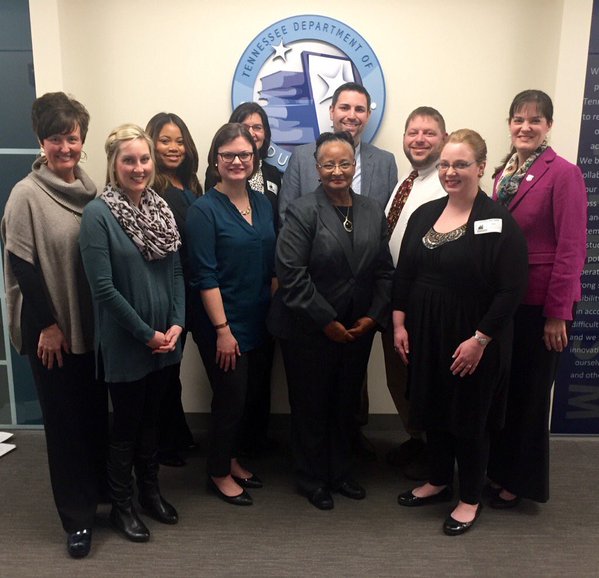
I was fortunate enough to go with a small group of Teacher Fellows to Nashville and present the report to Tennessee’s Commissioner of Education, Dr. Candice McQueen. Below is a picture from Hope Street Group’s meeting. I’m standing immediately to the left of Dr. McQueen.
McQueen picture
The short meeting went way beyond its scheduled time slot because she was interested in what educators had to say. Dr. McQueen asked many specific questions about the information contained in the report, and the Tennessee Department of Education is working on implementing some of the recommendations. It goes to show that, when allowed the opportunity, educator voice does make a difference. That fateful night in December was the first of many giant steps in the direction of elevating educator voice in Coffee County and throughout the state.

Another step in that same direction is this new “Tennessee Teacher Voice” blog. My vision for this blog is twofold. I intend to elevate educators' voices from my own county and from across the state by making the public aware of our solutions-oriented views on educational issues. I also want to highlight many of the positive activities occurring in educators' classrooms and schools of which the general public may be unaware. A quality education is the foundation of a thriving society. It impacts all of us!