Showing posts with label Tennessee Department of Education. Show all posts

Wednesday, December 28, 2016

2016: A Year in Review


2016 has been an amazing year, and it has served as another reminder to take the bad with the good. I would like to reflect on the top five educational stories, both personally and as a public school teacher in Tennessee.
At the top of my list is having the privilege of attending the national teacher of the year ceremony at The White House. I traveled to The White House because I was recognized as one of America’s most distinguished educators, and I participated in honoring Ms. Jahana Hayes as the national teacher of the year. The ceremony itself only lasted 30 minutes, beginning with a short speech from Ms. Hayes, who is a history teacher at John F. Kennedy High School in Waterbury, Connecticut. Her passion-filled opening remarks set a powerful tone and her enthusiasm for the teaching profession was palpable.

On the way back to Nashville, I had time to reflect on attending this absolutely sublime White House event. Continuing the spirit of this ceremony the best way I know how, I am committed to help my fellow educators elevate and express their voices and tell their stories. Teachers matter. No one knows how to improve the educational landscape better than us. We are the experts, and when we speak in unison, educators have a remarkably strong voice. It begins with educators telling their own stories and having honest conversations with stakeholders about what’s working in our profession and what’s not.

Next on my list is the complete meltdown of TNReady. Though not completely their fault, the Tennessee Department of Education took a black eye on this one. The failure of TNReady sent shock waves throughout the state’s public education system. Elementary and middle school students didn’t even get to take the exam, while high school students across the state went through the motions of taking the test and didn’t take it seriously. A state law was passed holding teachers harmless on their evaluations from these test scores, but this law doesn’t apply to schools and school districts. Meanwhile, TDOE changed testing vendors from Measurement Inc. to Questar and has some significant rebuilding to do in terms of its efficacy.

Number three on my list is something that happened within the last few days, when TDOE released its plan for public review of the Every Student Succeeds Act (ESSA). In case you haven’t been following, ESSA is the federal law that replaced No Child Left Behind, and it requires each state to develop its own plan on how it will meet the needs of its own students. Along with three other teachers from the high school, I recently attended a town hall meeting in Nashville where Commissioner McQueen and some of her TDOE cohorts explained the overview of their plan. I believe that TDOE’s ESSA plan needs some revision, but, overall, it sends a clear message that “all means all”--that TDOE is committed to educating all of Tennessee’s students, regardless of whether they are rich or poor, receiving special education services, or English Language Learners who just moved here from another country.

Number four on my list is the revelation from TDOE that the state’s science scores on the National Assessment of Educational Progress (NAEP) are “above the national average for the first time ever, doubled the national average for student growth, eliminated the performance gap between male and female students, narrowed the performance gap between white and black students in both grades, and narrowed the performance gap between white and Latino students in fourth grade.” Tennessee had previously scored above the national average in English Language Arts and math. This announcement is further proof that the public education system in Tennessee is on the right track. Historically, Tennessee has ranked at or near the bottom in public education.

Rounding out my top five education stories of 2016 is Mr. Trump’s appointment of Betsy DeVos as the future U.S. Secretary of Education. Putting a pro-charter and pro-voucher champion at the head of the nation’s public schools will certainly have “yuge” ramifications. One only needs to look at the education systems in Michigan and Louisiana (both are below the national average and dropping) to understand the devastating effects of diverting money from public schools in the name of school choice.


Sunday, October 30, 2016

Fool's Gold

Image result for fools gold

The Tennessee Department of Education (TDOE) received some excellent news last week. Tennessee’s students are continuing to improve on the National Assessment of Educational Progress (NAEP), which releases the nation’s report card that compares the respective education systems of every state in the country. Previously, Tennessee was hailed as the fastest improving state in the country for our gains in math and English/Language Arts. This time, Tennessee is being called “the star of the states” for our improvement in 4th and 8th grade science scores.

As a public school teacher, I am proud of my colleagues’ achievement--one that is all the more remarkable when you consider that Tennessee is 41st in the country in per-pupil spending and 39th in the country in average teacher salary. (Both of these figures are as of 2014.) It’s quite ironic that Tennessee’s students are making groundbreaking gains in math, English/Language Arts, and science, but remains near the bottom in education spending. Taxpayers across the state are certainly getting a huge bang for their buck.

TDOE cites two reasons for these huge student gains: higher standards and incredibly dedicated teachers. I would argue that Tennessee’s public schools are doing more with less than any other state in the country. Teachers and schools have learned to become incredibly resourceful. Not to rain on TDOE’s parade, but I can’t help but wonder if student growth on NAEP on the backs of underpaid teachers in under-resourced schools at the beginning of a teacher shortage crisis is a sustainable model.

Governor Haslam has mentioned many times that he wants Tennessee to become the fastest-improving state in teacher pay in the country, and he has recently approved the largest teacher pay increase without raising taxes in the state’s history. This is great for headlines and equally poor in practice. While not the case in my district, many Tennessee districts have withheld money that is owed to teachers from the state and will only give it to them in the form of performance bonuses. While legal, this practice is definitely unethical.

If TDOE and Governor Haslam are truly serious about continuing this momentum of NAEP gains, a few things need to happen, and quickly. First, the state needs to update and fully fund its BEP formula while ensuring that future raises go directly to teachers with no strings attached. Second, the option for performance-based pay needs to be taken away from school districts. Paying teachers for good test scores is a horrendously ignorant practice. Not only does it fail to work as intended, but it also encourages teachers to treat students as a means to get those bonuses by focusing too much on the state test. That, in turn, contributes to the teacher shortage crisis by giving students one more reason why they don’t want to become teachers themselves. Third, use some of the state’s nearly $1 billion surplus and give teachers another raise. The state has a large amount of ground to make up if we want to keep pace with other states in attracting the best and brightest teachers in the country.

I would love for Tennessee to be recognized among the best states in the country in public education. Just think what that would mean to the higher education community and to attracting more companies to set up shop here. As Tennesseans, we inherently have an independent spirit that uniquely enables us to be trend setters. The recent NAEP scores indicate that we are on the right track. I just hope that this train of public education improvement can avoid be derailed.

Sunday, September 25, 2016

TNReady, Reimagined


Most people are probably familiar with the TNReady debacles of last school year (or seven months ago this calendar year), the reverberations of which are still being felt in school buildings across the state. In response to this situation, the Tennessee Department of Education (TDOE) has hired a new testing company, Questar, to administer TNReady, and they have decided to phase-in online testing over a period of several years. In response to parents’ and educators’ concerns about the length of the tests, they have reduced testing times as well. From a teacher’s perspective, I would argue that all of these changes are positive, and a step in the right direction; but we can’t, and shouldn’t, be satisfied.
On the surface, it seems wonderful that elementary students will spend almost two hours and high school students approximately three hours less time testing than last year. The other side of that same coin, however, is that, starting in third grade, Tennessee students will still spend nearly eight hours of testing time in English/Language Arts, math, science, and social studies. To be fair, it will be spread out over the course of several days and among ten subtests in the four subject areas. Wait! Did I just say TEN subtests for a total of almost EIGHT hours? Is that really necessary?
Middle school students will take the same number of subtests, but the times are a tad longer, and by the time a student enters high school--especially junior year--it becomes especially ridiculous. Most high school juniors are enrolled in English 3, Algebra II, Chemistry, and U.S. History. All of these courses have a TNReady or End-of-Course exam. As such, a high school junior will spend nearly TEN hours testing in these four subjects, across a combined ELEVEN subtests!
The new federal Every Student Succeeds Act (ESSA), which goes into effect next school year, does actually lessen the testing requirements from No Child Left Behind and Race to the Top. Under ESSA, students in grades 3-8 must still be tested every year in English/Language Arts and math, and in science, once in grades 3-5 and one more time in grades 6-9. High school students are required to take one English, one math, and one science test. Tests in other subjects and additional tests in these three subjects can be given at the state’s discretion.  
While I sadly recognize that standardized testing will never completely go away, I have a solution to students being over-tested: Shorten the tests students are required to take and give them as few as possible. What would this look like, exactly?
In elementary and middle school, I propose keeping the social studies tests and eliminating: (a) two English/Language Arts subtests (keeping the writing test); (b) one math subtest; (c) and one science subtest. Student progress can still be monitored with shorter, more efficiently created tests. This would reduce the testing time from 8 hours to approximately 5.5 hours in grades 3-8. All of these tests should be aligned with the ACT so students will be prepared for the next level. Currently, there’s no alignment between ACT and TNReady.
For high school, I would recommend keeping the U.S. History test, but shortening it to two subtests totaling 90 minutes for the writing and objective components combined. As for the other subjects, school districts should have the option to use the ACT, which is already a requirement for 11th graders. This one exam would satisfy the federal testing requirement, it only takes about 3.5 hours, and students are now allowed one free retake. Otherwise, give the TNReady English III test (keeping the writing test but eliminating two of the subtests), give a 90 minute math test at the end of the junior year that combines Algebra I, Algebra II, and Geometry, and give a 90 minute science test that combines elements of biology and chemistry. There is no need for each of these subjects to have its own test because, again, student progress can be monitored with shorter, more efficiently created tests. The ACT and SAT have been doing it for decades.
Reimagining TNReady in this manner also makes it impossible to count it as part of a student’s report card grade; so, to ensure that they take the tests seriously, I recommend that a basic proficiency level be set on each test for students to receive their high school diplomas, with a requirement that students be proficient in at least three out of the four core subjects. After all, shouldn’t students have at least basic reading comprehension, writing, mathematics, science, and U.S. history knowledge when they graduate from high school?

Monday, September 19, 2016

Teaching Ghosts


One often overlooked aspect of the incessant testing and accountability culture that is so pervasive in today’s public education system is the fact that so many students are chronically absent from school. I have had several principals over the years (not my current one) who have told me that I can’t teach ghosts, and that I need to focus on the students sitting in front of me each day. There’s a certain amount of truth to that advice. It’s not healthy to worry about what I can’t control, and what I can control zaps almost all of the energy I have. Still, those students who are frequently absent and tardy to school will take the same TNReady test as the rest of my students, and if they don’t perform well (which is unlikely), they still count against my own evaluation as an educator and the school’s and district’s evaluations on the school report cards that are released each year.
The Tennessee Department of Education (TDOE) defines chronic absenteeism as a student who misses so much school--regardless of whether the absence is excused or unexcused--that the student is academically at risk of passing the school year. Usually, this means that the student has missed 10% or more of the instructional days, which would amount to at least 18 absences per school year. Discipline problems frequently accompany absenteeism because students are lost and bored when they return to school. TDOE is aware of this statewide problem and are working towards solutions.
Because of my role as a Hope Street Group (HSG) Teacher Fellow, I had the opportunity to participate in a webinar last week with TDOE on this very issue. Some of the information that was revealed during that webinar was interesting and eye-opening. While absentee rates vary greatly across the state, the largest absentee rates are at the two polar opposites of the educational spectrum--PreK and 12th grade, at 24% and 25%, respectively. African-Americans, students who are economically disadvantaged, and students with disabilities are the most likely groups of students who will miss school, at 17%. Across all grade levels, students who miss two or more days in August are five times as likely as their peers to be chronically absent. Ninth grade is a crucial year for students to attend school, as students in this grade level who are chronically absent are 38% less likely to graduate from high school.
Students miss school for a variety of reasons. Sometimes they have a strong aversion to school and don’t want to come because of: academically and social struggles, bullying, ineffective school discipline, negative school experience from the family, and undiagnosed disabilities. Other students are simply disengaged from a lack of engaging and relevant instruction, few meaningful relationships with adults in the school, and a poor school climate.
I would be remiss if I failed to mention that Coffee County Schools were highly praised by TDOE in the webinar. While many school systems saw their absentee rates increase last year, the opposite is true in Coffee County, where our attendance rates have increased. This is certainly something to be celebrated. September is “Attendance Awareness Month” in Tennessee, and each Coffee County School is doing something difference to bring students’ awareness to the importance of coming to school.
The recently passed Every Student Succeeds Act (ESSA), which replaces the federal No Child Left Behind Act, returns an extraordinary amount of power to states on how they want to operate their education systems. ESSA will go into effect next school year, and TDOE is working on how to eliminate obstacles to student success, like chronic absenteeism and student discipline. HSG is currently conducting in-person focus groups with teachers across the state on these two topics, and the results will be funneled to TDOE so they can make well-informed decisions based on teacher input. Running concurrently with the focus groups is HSG’s online survey, which will remain open until Friday, October 14th so that teachers can have their voices heard. The survey can be found at http://www.surveygizmo.com/s3/2982487/TNFall16.

Tuesday, June 21, 2016

All Means All


If you have a child enrolled in public schools, then he or she is in Response to Instruction and Intervention, or RTI2, whether you realize it or not. The Tennessee State Board of Education adopted RTI2 in 2013 and mandated that districts begin implementing it in 2014 through a phase-in process that is just now reaching high schools across the state.
What, exactly, is RTI2? Basically, all students are divided into three groups: the majority of students who are at or near grade level in math, reading, or Language Arts are in Tier 1, students who are considered to be in the bottom 25th percentile in either of those subjects are in Tier 2, and students in the bottom 10th percentile are in Tier 3. In general, 10-15% of students will qualify for Tier 2 intervention and 3-5% of students will qualify for Tier 3 intervention. Students in Tier 2 or Tier 3 intervention will receive further instruction in addition to what they receive in the regular education classroom. The idea behind this program is to keep students from slipping through the cracks when it has been determined that they are lacking mandatory skills, such as reading comprehension or solving word problems in math.
While the intentions of RTI2 are great, this mandated program came with guidelines on how to implement it and no additional funding. As you might expect, educators have mixed feelings about RTI. Essentially, schools are now asked to do more of what they’re already doing anyway--help students. At the same time, RTI2 also stretches educational resources that are already pretty thin.
Hope Street Group Teacher Fellows worked with the Tennessee Department of Education (TDOE) to survey and conduct focus groups with teachers across the state about what’s working with RTI2 and what’s not. Most teachers use a blend of purchased and currently existing classroom resources and most are in favor of the program and have seen students improve, which, of course, is the ultimate goal. With that said, there are some specific areas of RTI2 that need to be improved.
Teachers expressed their collective voice, and the results of the survey and focus groups indicate that TDOE should consider providing schools with additional support in four key areas: scheduling and structure, improving school attitudes toward RTI2, communication around RTI2, and resources and staffing. Because some teachers believe they do not have enough resources and staffing, TDOE should consider providing additional funding to support implementation, and they should provide additional training to teachers on how to successfully implement this program. Teachers want this training to include explicit information on where they can find resources so they can best help their students.
The good news is that additional training is on the way. I just completed training from TDOE on instructional strategies for teachers--especially for those who teach students in Tier 2 or Tier 3. Twenty-nine teachers from around the state and myself will train approximately 1,200 RTI2 teachers the week of June 27th. RTI2 classes are purposely smaller, averaging around 10-15 students. This means that roughly 18,000 Tier 2 and Tier 3 students will benefit from this training, with even more Tier 1 students who will benefit.
Our society generally appreciates and respects educators for the hard work that we accomplish every day without really knowing what that hard work entails. Effective teaching involves much more than creating solid lessons and executing them. Students who are lacking specific skills must be identified and remediation must occur so they do not remain perpetually behind their peers and so that they can eventually graduate and be productive members of society. Many people are unaware that RTI2 exists and how difficult it is to help students who have fallen behind when their motivation is low and when proper training and resources are lacking. Every school in every school district seems to do it differently, with varying degrees of success. At the end of the school day, the expectation of educators across the state is that all students can and will learn.
If you are interested in reading the Executive Summary of Hope Street Group's report over RTI, please click on this link. If you want to read the FULL report, click here!

Friday, June 17, 2016

Measuring the Unmeasurable


Last week, I attended a convening of Hope Street Group teacher fellows from across the state. There are 30 of us who are all dedicated to elevating teachers’ voices in this state. On the first day of the convening, I was blessed to participate in a listening session over state testing with Dr. Candice McQueen, the Commissioner of the Tennessee Department of Education (TDOE). She will travel around the state and conduct more of these listening sessions so that teachers can tell her directly how the state can improve its system of evaluating students.

Many great ideas were expressed in this listening session, the details of which I don’t want to publicize at this time because education policy is a tricky thing. Nothing is ever changed solely in isolation without affecting something else. I don’t know how many of the good ideas that we expressed are actionable, but I left that session feeling confident that Commissioner McQueen listened to them intently.

Lunch quickly followed this listening session, and at my lunch table we continued to discuss the weighty topic of evaluation, which veered into a discussion on how teachers and schools are evaluated.

Most teachers across the state are evaluated using the Tennessee Educator Acceleration Model, or TEAM. In a nutshell, this model that is used for classroom observations uses a rubric that lists characteristics in several different domains on a 1, 3, or 5 level, with 5 being the highest. After the teacher’s lesson is evaluated, there is a post-conference where the teacher meets with the evaluator (usually a principal) and the strengths and weaknesses of the lesson are discussed. Classroom observation(s) comprise 50% of a teacher’s overall evaluation score for that year, which is also on a scale of 1-5. According to TDOE, the TEAM evaluation model improves the quality of education and teachers feel more positive about it than ever. Anecdotally, no one at my table--nor any other teacher that I have ever talked to about the TEAM model--could support that notion. The way teachers are evaluated in this state is ridiculously flawed.

Schools have been graded using a school report card for a number of years now. New to this report card (thanks to the state legislature) will be grades that range from A to F for every school. These grades will be based primarily off of how well students perform on state tests as well as national tests like the ACT. This raised a series of questions during our lunch discussion. What performance levels signify an “A” versus a “B” or “C”? Are schools who obtain an “A” on the school report card actually graduating students who are well-prepared for college and the “real world,” or are they better at preparing their students to test well?

The larger issue here is that in education, we constantly strive to measure the unmeasurable. For example, on a student’s report card, a grade of 75 is a “D” and a grade of 85 is a “B.” As a teacher, how on earth can I honestly say that the “B” student has mastered 10% more of the knowledge than the “D” student? I can’t, because it’s it’s not quantifiable. Likewise, is a teacher who is considered to be a level 5 significantly better than a level 3 teacher on the TEAM rubric? On the school report card, will an “A” school be significantly better than a “B” or “C” school?

I greatly appreciate Dr. McQueen taking the time to listen to a group of teacher leaders from around the state. Without question, there are areas of improvement for TNReady. Because the law requires state testing, our students deserve to have the best evaluation system that we can provide. Hopefully, the state’s ensuing discussion over how to improve TNReady will boil over into other areas of evaluation that correspondingly have glaring areas of improvement. There are more organic methods of evaluating teachers and schools than subjectively grading them. When we figure this out, Tennessee educationally will be a model for the nation and the positive change will be precipitous.

Sunday, May 15, 2016

In Holy Matrimony

Spring is here, summer is right around the corner, and with it the busiest time of year for weddings. Interesting fact: The average length for an engagement is 14 months before the lucky couple ties the knot. Unfortunately, the divorce rate still hovers around 50 percent.
In the education world, this time of year usually means state testing, but it came early this year--the last week of April--for the schools that actually had a state test to give. Like dozens of other states around the country, Tennessee is experiencing commitment issues to our state’s standardized test.
Since the passage of President Bush’s No Child Left Behind Law in 2002 which forced states to adopt a statewide standardized test, Tennessee has wed and dissoluted three different times. Three uniquely different tests in 14 years may not sound too horrible, but much of this change has occurred recently. Since 2014, we have parted ways with TCAP/End of Course and had an annulment with the PARCC Assessment because they’re not from around here and they were in partnerships with other states, which we knew about the entire time. We got so upset at PARCC (It wasn’t them, it was us) that we passed a law stating that we would never allow ourselves to date them again--and that went for PARCC’s twin, Smart Balanced, too.
The Tennessee Legislature, who is largely responsible for creating the current educational pandemonium, and the Tennessee Department of Education are at an interesting and vitally important crossroads. The state’s attachment to TNReady only lasted a year, and few would argue against this separation.

There are many, many more testing fish in the sea. One possible option is to stick with the TNReady test that we spent time and money creating, and find a different vendor for administering it. Educators would know what to expect from the test, and most of this year’s test questions are going to be released over the summer. This option reminds me of arranged marriage. We would kind of know what we are getting into, and it could work out nicely--or not.
Another option is to cut our losses and use the ACT Aspire suite of assessments. On one side, this would mean another drastic change for educators across the state because they would have to learn how to prepare students to pass yet another state test that’s substantially different from the previous one. It will be more expensive to administer than TNReady and possibly more than if the state had stayed with PARCC. The ACT has a horrible track record of predicting future college success, which is rather ironic for a college preparatory exam. On the other side, we would know exactly what we are getting, and there should be no administrative issues like we ran into with TNReady. High school students have taken the ACT for a very long time, and there are other states who use the ACT Aspire suite of assessments for elementary through high school. Also, due to its relative predictability, it’s easier to prepare students to pass it, and the ACT is already part of the school report card that is published every year.
The tricky thing about this decision is that Tennessee has almost no time to make a good one. All of the state’s eggs were in the TNReady basket, and an accountability measure for students must exist for the upcoming school year.

Meanwhile, teachers across the state are nervous because of the unknown and are screaming for consistency. Like it or not (and we don’t), a significant portion of our jobs as educators is to ensure that students are prepared to pass the state test. Teachers’ reputations as professionals and even our livelihoods are at stake. The constantly changing testing landscape diminishes the value of any state test that will come in the future. A different test every year to every other year means that teachers, as well as the state, will have a hard time tracking yearly student progress, thereby preventing any reliable comparisons among schools and districts. I sincerely hope that whatever the state decides to do, it’s a marriage that will last.

Sunday, May 1, 2016

Keep Calm and Stay Positive

Unless you are supremely talented, it takes several tries to master a new skill. As a teacher, my lessons are sometimes better in the afternoons than in the mornings because I’ve had an opportunity to tweak them throughout the day. This same concept applies to field of education in general.
Five years ago, Tennessee adopted the Common Core State Standards for math and Language Arts. This change was desperately needed because the previous state standards were among the weakest in the country and high schools were graduating students en masse without the skill sets needed to successfully enter college or the work force. Since that time, CCSS has undergone a lengthy public review process in which nearly three-fourths of the comments for revision were made by experts--teachers across the state who have been teaching the standards the past several years. The new version of these standards has just been released, and they are much improved. The language in the standards is easier to understand and the layout on the page also makes more sense as it better allows educators to see the progression of each standard through the different grade levels. It took a few years for the state to get it right, but our children are greatly benefitting from the process of implementing higher standards. I’ve seen it with my own fifth grade daughter.
In case you haven’t heard about the latest TNReady debacle, after the Tennessee Department of Education decided to pull the plug on online testing and move to paper and pencil testing, Measurement Inc. has once again failed to deliver the test materials to schools on time. This happened during the first part of TNReady back in February, and Measurement Inc. has done little to keep from repeating the same mistake again. This time, all high schools have their materials but elementary and middle schools across the state vary widely in the amount of materials they have received, and the Department of Education has vowed that they will not push back the testing window--meaning, if the materials don’t arrive in time, then no test will be given at all.
Tennessee’s Commissioner of Education, Dr. Candice McQueen, inherited the contract with Measurement Inc. due to poor decision-making by the Tennessee Legislature to scrap the PARCC Assessment (whose online assessment worked without any glitches this year) in favor of a cheaper option that isn’t controlled by testing giant Pearson. Dr. McQueen has said publicly that she has lost all faith in Measurement Inc., and House Democrats have called for the Tennessee Comptroller of the Treasury to look into how much the state has paid this testing company that is having a horrible time successfully administering a test. Additionally, after hearing the cries from parents and teachers that TNReady is too long (and it is), changes will be made next year to shorten it, but it’s unclear at this time what that will look like.
It’s a shame that Tennessee’s testing situation is such a mess, because TNReady is a greatly improved assessment over the previous TCAP/EOC assessments. Instead of entirely being multiple-choice, TNReady requires students to explain their answers in writing and it contains multiple-response questions that have more than one correct answer. It moves beyond the simple recall of information to analyzing the concept behind why the correct answer is what it is.

TNReady is in its first year of implementation and it is too early to start reaching for the panic button. Because of Measurement Inc.’s blunders, TNReady will not count this year as part of teachers’ evaluations (though it could still be factored in down the road) and it will not impact students’ report card averages. Tennessee House Democrats have again called for a three-year moratorium on holding districts accountable on TNReady measures. This common-sense solution will hopefully gain some traction in the next legislative session because, like what happened with the standards, it will take some time to get the kinks worked out of TNReady. This will hopefully mean that the state will find a new vendor for TNReady because Measurement Inc. have proven themselves more than incompetent. In the meantime, let’s take a collective deep breath. The education system in Tennessee is vastly improving. This process takes time, and there will be speed bumps on the road to success, despite everyone’s best intentions.

Monday, April 25, 2016

Introduction

As a public school educator, I have certainly shared and commented on many education-related topics on Facebook and Twitter because being an educator is far more than a job--it’s a passion that wakes me up in the morning and gets me energized for the day. Social media is a good venue for educators to express their voices. Take Tennessee's voucher bill, for example. Teachers in this state were strongly against it, and social media played a role in keeping vouchers from becoming a reality. The defeat of vouchers was a rare win for Tennessee’s educators--most of whom, like myself, are active on social media platforms. We comment and share and voice each other's opinions in a seemingly strong cacophony of teacher voice; yet, educators often feel left out of the decision-making process of their own profession. I, too, sometimes feel like a powerless pawn in a game of chess in which I don’t have control over the movement of any of the pieces. What’s worse is that there are organizations from within Tennessee and from around the country who are determined to privatize education, and they do a great job of miseducating and misleading the general public about their own public schools by focusing on the negative and by publishing false information. This hurts educator morale, and, as a result, we are not expressing our collective voice at the same decibel level as before.

When the opportunity came knocking for me to join Hope Street Group, I eagerly applied. Hope Street Group, in its first year in Tennessee, is a non-partisan, non-profit organization whose mission is to improve public education through elevating and broadcasting educator voice. After all, educators know best what’s working and what’s not working in their classrooms and with their students. Including myself, there are currently 29 Hope Street Group Tennessee Teacher Fellows across the state, and last semester we conducted an online survey and in-person focus group meetings on the topics of educator leadership and professional development. This information was compiled into a report by a third party and was delivered to those who make decisions on educators’ behalf--including the Tennessee Dept. of Education, lawmakers, and school boards. 

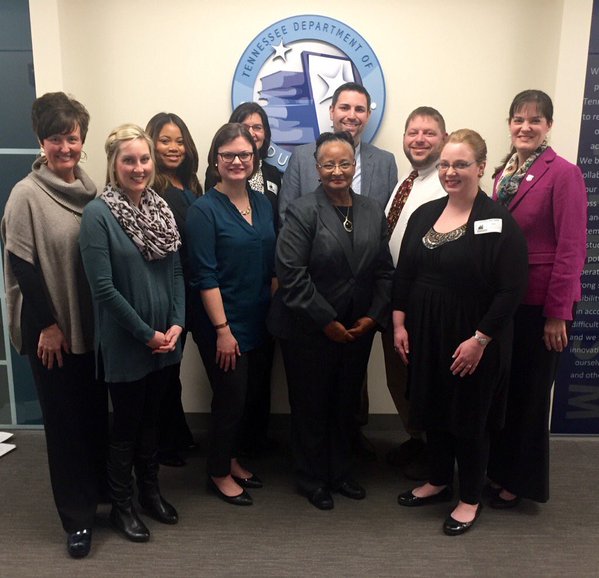
I was fortunate enough to go with a small group of Teacher Fellows to Nashville and present the report to Tennessee’s Commissioner of Education, Dr. Candice McQueen. Below is a picture from Hope Street Group’s meeting. I’m standing immediately to the left of Dr. McQueen.
McQueen picture
The short meeting went way beyond its scheduled time slot because she was interested in what educators had to say. Dr. McQueen asked many specific questions about the information contained in the report, and the Tennessee Department of Education is working on implementing some of the recommendations. It goes to show that, when allowed the opportunity, educator voice does make a difference. That fateful night in December was the first of many giant steps in the direction of elevating educator voice in Coffee County and throughout the state.

Another step in that same direction is this new “Tennessee Teacher Voice” blog. My vision for this blog is twofold. I intend to elevate educators' voices from my own county and from across the state by making the public aware of our solutions-oriented views on educational issues. I also want to highlight many of the positive activities occurring in educators' classrooms and schools of which the general public may be unaware. A quality education is the foundation of a thriving society. It impacts all of us!