Showing posts with label Vouchers. Show all posts

Thursday, April 18, 2019

Coffee County Teachers Stage “Walk In” to Raise Awareness about Vouchers


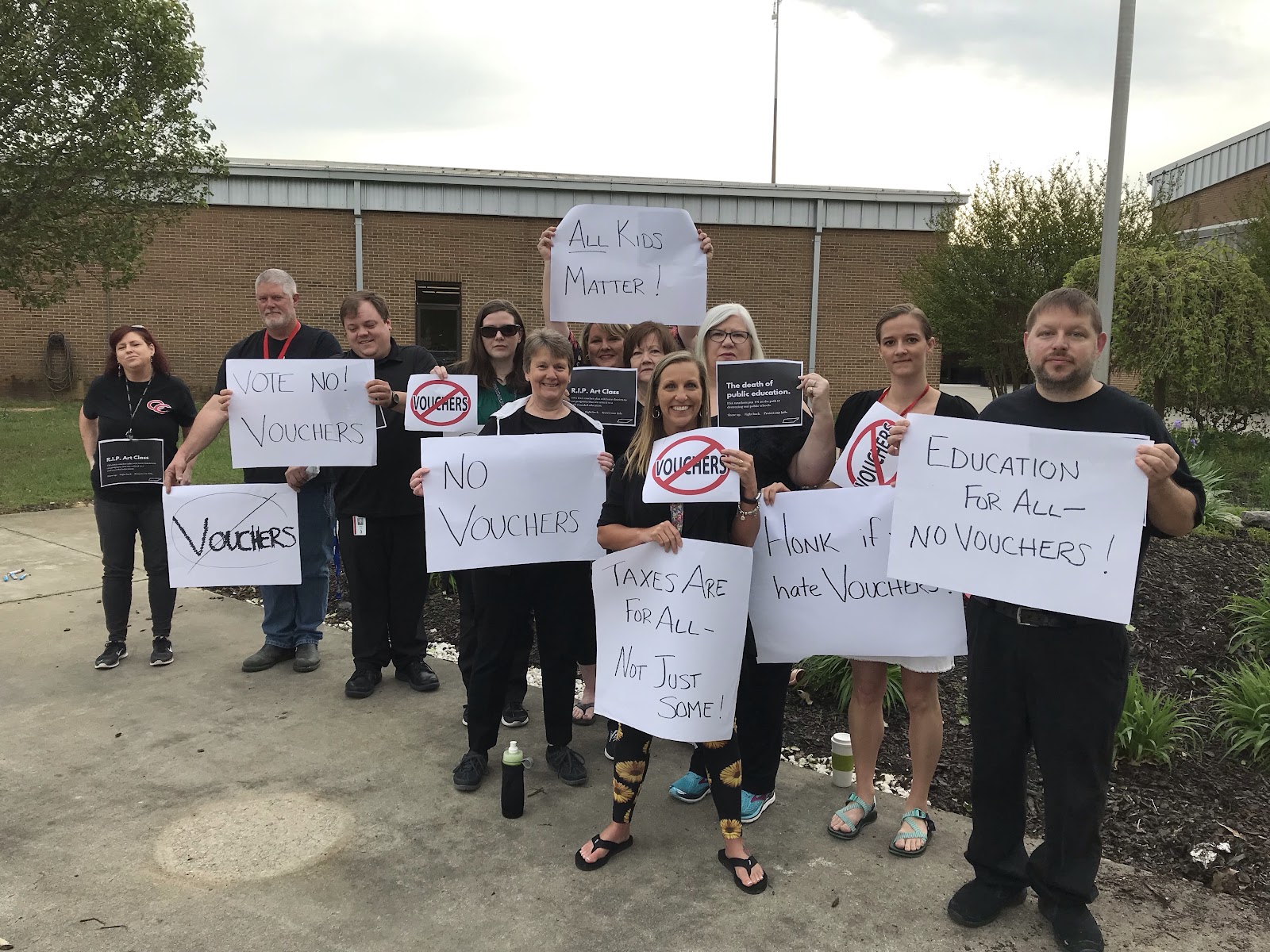
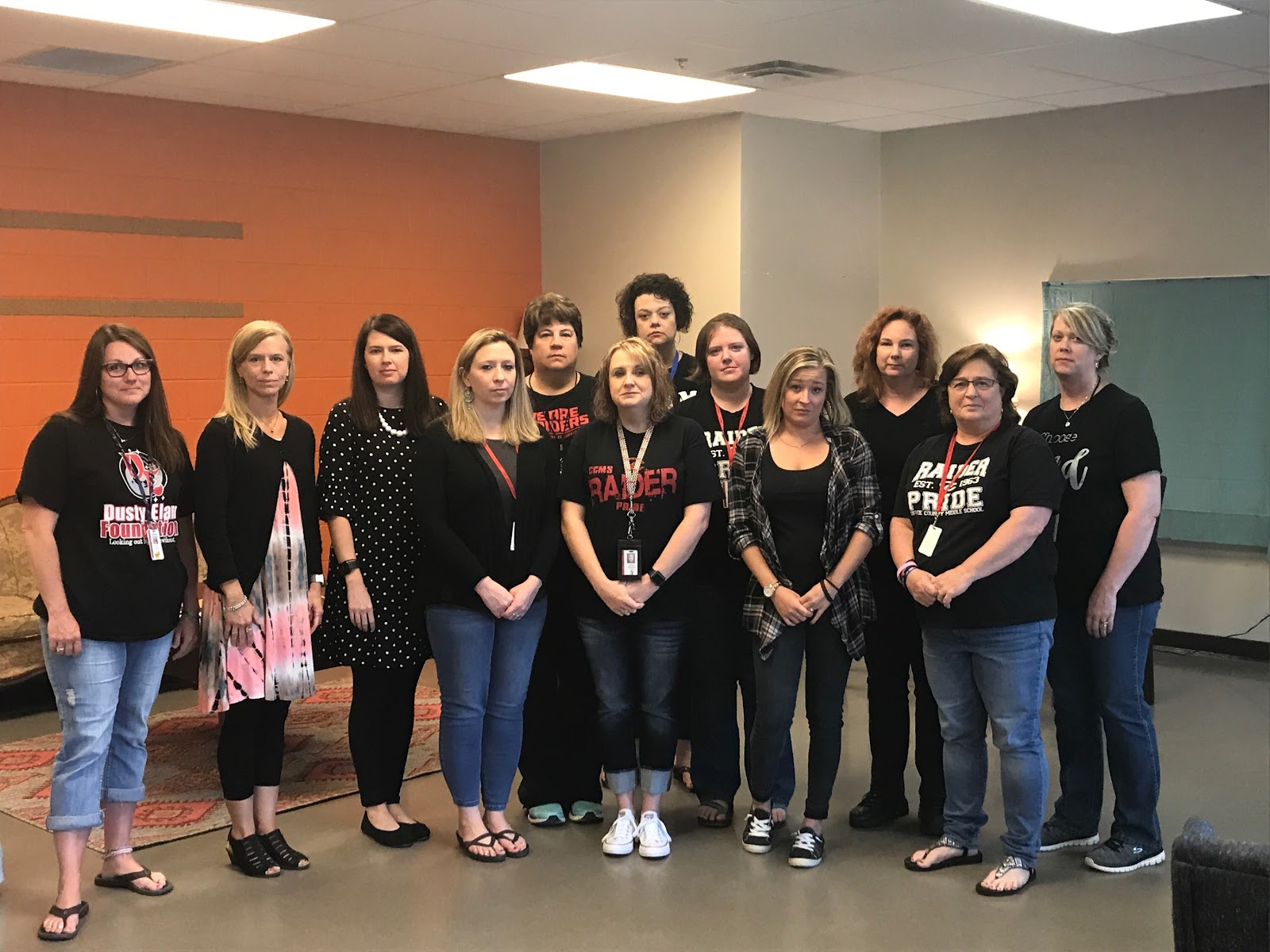
On the morning of April 17th, a group of teachers gathered at Coffee County Central High School and Coffee County Middle School for a “Walk In” to raise awareness about the current Educational Savings Account (also known as voucher) bill that is working its way through the Tennessee Legislature. A “Walk In” is when teachers gather in front of the school building while they are off-duty before school starts and hold up signs for parents to see while dropping their children off at school. This event was organized by Mike Stein, the President of the Coffee County Education Association.

House Bill 939/Senate Bill 795, if passed, would rob over $110 million from public education while causing local property taxes to rise. Eligibility for the ESA program initially is limited in counties with at least three schools in the bottom 10% — but zoning in a bottom 10% school is not required. Due to state law, there will always be a list generated of the bottom 10% of schools. That will play a role in vouchers expanding to other counties across Tennessee. This has happened in other states.

In Arizona, 75 percent of all ESAs are used by the affluent families zoned for A or B rated schools. Most vouchers in Indiana now go to affluent families who never intended to send children to public schools. The ESA program is designed for families who already send children to private school or homeschool and does nothing to improve struggling schools across the state. In fact, those schools will be weakened under this current legislation.
Currently, taxpayers do not currently subsidize private school tuition, but as more families take ESAs for their incoming kindergartners who they never planned to send to a public school, a new ongoing cost will shift to local taxpayers. The Senate version of this bill will allow funds to be used for homeschooling, which has great potential for abuse. ESAs in other states have experienced a significant amount of fraud and abuse. These states believed they had proper safeguards in place to prevent fraud and abuse, but still lost hundreds of thousands of taxpayer dollars.

Additionally, students who use ESAs for private and homeschool are not held to the same accountability standards as public schools, putting those students at risk for falling behind their peers in traditional public schools. Private schools do not have the same certification and expertise requirements as public schools. In the House version, voucher students do not have to take state tests in Social Studies and Science, and in the Senate version students will not have to take any type of state test, which can be substituted for any nationally-normed test. ESAs and vouchers don’t work and actually harm student learning. Research clearly shows voucher students fall behind their peers who attend to private schools or homeschooling.

When Mike Stein e-mailed Rep. Rush Bricken stating his concerns about this bill, Mr. Bricken sent this reply: “I appreciate you taking the time to let me know how you feel about HB 939. I support and believe in public education. I am not fully for this legislation but want to wait to see what comes out of committees before I finally decide.” Despite all of the pitfalls of this legislation, Rep. Bricken is hesitant to do what many other lawmakers have done and stand on the side of public education and against this bill. He will vote on this bill within the next few days and can be reached at (615) 741-7448 and rep.rush.bricken@capitol.tn.gov. If you don’t live in Coffee County, you can quickly contact your representative by going to  https://actionnetwork.org/letters/no-to-vouchers.

Sunday, April 2, 2017

The Gutting of America's Public Schools


The following article was co-written by Hope Street Group Tennessee Teacher Fellow Debbie Hickerson. She is a fifth grade teacher at Cason Lane Academy in Murfreesboro, TN.

Keep your eye on what is being proposed at the federal government for our public school system. Have no illusions. The school voucher system will gut public school funding across the country. A voucher does not provide enough money for full tuition. Those who want to use vouchers to put their children in private school will need to supplement the tuition cost out of pocket. This means those in poverty and the working poor will not be able to access private schools. That leaves those in the public school system who cannot afford private school. Public schools will lose a majority of their funding to the vouchers, leaving underfunded public schools with a high proportion of children in poverty. Statistically, high poverty schools don’t do well on standardized tests. Universally low test scores, because of the vouchers, will feed into the false narrative that public schools are failing the students that they serve. This is not equitable education for all. Don't we want ALL of our children in America to have a good education?

To those of you not in the education field, you may not understand that having a school voucher system doesn't just mean you can choose any school you want your kid to go to. It also means the public education program will be dismantled. Let me explain.

House Resolution 610, introduced by Rep. Steve King of Iowa (yes, the same person who tweeted something so racist that people cancelled their vacations to Iowa), will effectively start the school voucher system to be used by children ages 5-17 and starts the defunding process of public schools. It will eliminate the Elementary and Secondary Education Act (ESEA) of 1965, which is the nation's educational law that provides equal opportunity in education. The ESEA established what are known as title programs and, because these are so important to maintaining free and equitable public education, Congress has reauthorized ESEA every five years since 1965. Under President George W. Bush, ESEA became known as No Child Left Behind; under President Barack Obama, it was rebranded the Every Student Succeeds Act (ESSA) and passed Congress with rare bipartisan support.

ESSA is a comprehensive law that covers programs for struggling learners, advanced and gifted kids in AP classes, ESL classes, classes for minorities, rural education, education for the homeless, school safety (Gun-Free schools), monitoring and compliance, and federal accountability programs. Yes, there are all of these programs happening in our education system, in addition to academics, and they will disappear if this bill becomes law. Some things ESSA does for children with disabilities include ensuring access to the general education curriculum, and accommodations on assessments. It also requires local education agencies (i.e. the school systems) to provide evidence-based interventions in schools with consistently under-performing subgroups.

House Resolution 610 also abolishes the Nutritional Act of 2012 (No Hungry Kids Act) which provides nutritional standards in school breakfast and lunch. It dangerously has no wording whatsoever protecting kids with special needs, no mention of the Individuals with Disabilities Education Act (IDEA) nor the Free Appropriate Public Education (FAPE) act.

Please call your representative and ask him/her to vote NO on House Resolution 610. If you don’t know who your house representative is, go to http://www.house.gov/htbin/findrep and type in your zip code. Please call all local offices and the D.C. office. E-mails are okay, too, but phone calls are much more effective and really will not take much of your time at all.

Monday, February 6, 2017

Vouching Delusion


Last week, Governor Haslam gave his annual State of the State Address and, for a fleeting moment, it appeared that he was truly supporting public education. I certainly give him credit for saying all the right things and checking every box. Gov. Haslam supported fully-funding the Basic Education Program (BEP) Formula and giving public school teachers another raise--two things that all teachers staunchly support. He also unveiled a new initiative--the Reconnect Act--that will afford adults the same opportunity as high school students to attend a community college for free and earn a degree. All of these proposals, if successfully implemented, will be profoundly wonderful things for public education and business in this state.

Much like the Powerful Wizard of Oz, who turned out to not have any special powers at all, I skeptically wondered what was lurking behind that curtain. I didn’t have to wait long; the very next day, Rep. Bill Dunn (R-Knoxville) announced his plan to re-introduce nearly identical voucher legislation to what he sponsored last year, which Governor Haslam said he would sign if it passed through the Legislature. It’s dizzying trying to understand how a governor can simultaneously support Tennessee becoming “the fastest improving state in teacher pay” in the country and school voucher legislation that unscrupulously robs money from public schools and puts that money into the hands of businesses in the form of charter and private schools.

Last year’s voucher bill had unusually strong momentum, but it was stopped in its tracks by classroom teachers across the state, like myself. I called and e-mailed all of the members of the state house and senate education committees. A very small number--maybe three or four--actually called me back and wanted to learn more about why I oppose vouchers. While I’m proud to have played a role in defeating last year’s voucher bill, I resent having to play this political game every single year. A coalition lead by the Tennessee Education Association (TEA), the Tennessee School Board Association (TSBA), and the Tennessee Organization of School Superintendents (TOSS) made it clear that Tennessee’s educators are unified in their view that vouchers will destroy our surging education system.

It’s noteworthy that Rep. Dunn doesn’t refer to them as vouchers in House Bill 336; he calls them “opportunity scholarships.” In so doing, he is putting a wolf in sheep’s clothing. Don’t be fooled. According to an EdNext 2016 survey, the 37% of the general public supports vouchers, whereas almost 50% support opportunity scholarships. Both of these percentages have dropped 15% in the last ten years. Public support for this program continues to wane because people have had the opportunity to see for themselves the harmful effects of voucher legislation that has passed in many states around the country.

This begs the question: Why are Rep. Dunn and Gov. Haslam advocating a voucher bill that the general public doesn’t support and that educators obviously oppose? I argue it’s the same reason why so many Republican U.S. Senators (including Tennessee’s two senators) stubbornly support Betsy DeVos for Education Secretary, despite a bipartisan union of concerned citizens flooding their phone lines and writing hundreds of thousands of letters in opposition. That reason is money. The DeVos family has donated $8.3 million to Republican U.S. Senators’ campaigns over the last two years. Likewise, powerful pro-voucher and pro-charter lobbying groups (like Devos’ group American Federation for Children) are extremely active on the state level and work hard to get legislation introduced and passed.

If Dunn and Haslam truly want to help Tennessee’s children, they would work with TDOE to destroy the silos of information, self-contained within each district, of what works for students and what doesn’t. If they wanted to help children succeed, they would eliminate the ridiculous A-F grading system that measures how well schools prepare their students for TNReady. This grading system has failed in Texas and needs to be rescinded in Tennessee before it is implemented. There’s already plenty of information out there on how well schools perform. Simplifying that into a single “grade” in nonsensical. If they wanted to help children succeed, then stick to Gov. Haslam’s original proposal of giving teachers raises and fully-funding the BEP, and then get out of the way and let us concentrate on what we do best--educating future generations.

Wednesday, December 28, 2016

2016: A Year in Review


2016 has been an amazing year, and it has served as another reminder to take the bad with the good. I would like to reflect on the top five educational stories, both personally and as a public school teacher in Tennessee.
At the top of my list is having the privilege of attending the national teacher of the year ceremony at The White House. I traveled to The White House because I was recognized as one of America’s most distinguished educators, and I participated in honoring Ms. Jahana Hayes as the national teacher of the year. The ceremony itself only lasted 30 minutes, beginning with a short speech from Ms. Hayes, who is a history teacher at John F. Kennedy High School in Waterbury, Connecticut. Her passion-filled opening remarks set a powerful tone and her enthusiasm for the teaching profession was palpable.

On the way back to Nashville, I had time to reflect on attending this absolutely sublime White House event. Continuing the spirit of this ceremony the best way I know how, I am committed to help my fellow educators elevate and express their voices and tell their stories. Teachers matter. No one knows how to improve the educational landscape better than us. We are the experts, and when we speak in unison, educators have a remarkably strong voice. It begins with educators telling their own stories and having honest conversations with stakeholders about what’s working in our profession and what’s not.

Next on my list is the complete meltdown of TNReady. Though not completely their fault, the Tennessee Department of Education took a black eye on this one. The failure of TNReady sent shock waves throughout the state’s public education system. Elementary and middle school students didn’t even get to take the exam, while high school students across the state went through the motions of taking the test and didn’t take it seriously. A state law was passed holding teachers harmless on their evaluations from these test scores, but this law doesn’t apply to schools and school districts. Meanwhile, TDOE changed testing vendors from Measurement Inc. to Questar and has some significant rebuilding to do in terms of its efficacy.

Number three on my list is something that happened within the last few days, when TDOE released its plan for public review of the Every Student Succeeds Act (ESSA). In case you haven’t been following, ESSA is the federal law that replaced No Child Left Behind, and it requires each state to develop its own plan on how it will meet the needs of its own students. Along with three other teachers from the high school, I recently attended a town hall meeting in Nashville where Commissioner McQueen and some of her TDOE cohorts explained the overview of their plan. I believe that TDOE’s ESSA plan needs some revision, but, overall, it sends a clear message that “all means all”--that TDOE is committed to educating all of Tennessee’s students, regardless of whether they are rich or poor, receiving special education services, or English Language Learners who just moved here from another country.

Number four on my list is the revelation from TDOE that the state’s science scores on the National Assessment of Educational Progress (NAEP) are “above the national average for the first time ever, doubled the national average for student growth, eliminated the performance gap between male and female students, narrowed the performance gap between white and black students in both grades, and narrowed the performance gap between white and Latino students in fourth grade.” Tennessee had previously scored above the national average in English Language Arts and math. This announcement is further proof that the public education system in Tennessee is on the right track. Historically, Tennessee has ranked at or near the bottom in public education.

Rounding out my top five education stories of 2016 is Mr. Trump’s appointment of Betsy DeVos as the future U.S. Secretary of Education. Putting a pro-charter and pro-voucher champion at the head of the nation’s public schools will certainly have “yuge” ramifications. One only needs to look at the education systems in Michigan and Louisiana (both are below the national average and dropping) to understand the devastating effects of diverting money from public schools in the name of school choice.

Sunday, November 27, 2016

The Future, with Betsy DeVos


I heard a commercial on my car radio from an over-eager pitch man on the way back from working out on a mild summer morning in early June: “Parents! Don’t delay! Enroll your student at Freedom Preparatory Academy by July 1st, and you’ll receive a $50 Visa gift card and be entered into a drawing to win a FREE Chromebook. You have many choices where you send your child to school. Experience the freedom of Freedom Preparatory Academy.” I quickly snapped off the radio. These charter school advertisements are so abundant that you’d think there was another presidential election going on. Instead, after two years of Betsy DeVos running a U.S. Department of Education that greatly incentivized states to create more charter schools, and with a Republican supermajority in our state legislature, charter schools have been popping up everywhere.
President Trump sold it well. I have to give him credit for that, at least. He fed the country false information about how we should have more choices of where to send our children to school, and that the competition created by charter schools will improve the education system for everyone. “It’s like a business,” he said. “It’s good for the consumer when businesses compete with each other, and it’s good for students when schools do the same.”
On the surface this sounds like a logical argument. Teachers tried to be the voice of reason and educate the public about why this didn’t make sense and why the expansion of charter schools is harmful to students. Well, many of us tried, anyway. Unfortunately, even on this crucial issue, teachers did not present a united voice. Too many voted against our students’ interests and voted for political candidates with an “R” next to their names. It was clear what would happen to the country’s public education system under Republican control. They’ve been busting teachers’ unions and pushing “school choice” initiatives for decades.
Those of us who tried to raise awareness about the dangers of “school choice” expansion pointed out that these initiatives steal money from an already underfunded public school system. We attempted to explain that schools can’t be run like businesses because, quite simply, they’re NOT businesses; they’re a bureaucracy. A business has the ability to choose from the finest of materials to make their products. Public schools take everyone. Competition among businesses drives down prices and benefits the consumer. Competition among schools lessens the quality of education because schools fight for the same raw materials--students and teachers. The good teachers and the good students become spread out across several schools. With a lower enrollment at each school, the schools themselves are more costly to operate. It used to be that charter schools were regulated, but now, under the new Trump administration, businesses are allowed to run publicly-funded schools with no expectation that they actually perform on the same level as other schools across the state.
This is exactly what happened in Michigan before Betsy DeVos took responsibility of the nation’s public school system. The warning signs for the downfall of the American education system were there. The New York Times ran several stories about this, like “A Sea of Charter Schools in Detroit Leaves Students Amiss” and “The Risk with Betsy DeVos,” but people blew them off as being from a biased liberal media.

So here I am, living in the new normal in 2018: where schools are so desperate for students that they’re offering gift cards to get parents to enroll their children there, where states accepted federal money to pass anti-union legislation and made teachers’ unions a relic of the past, and where “school choice” has led to an uneven playing field that clearly benefits the wealthy. If only teachers across the country had inspired their local communities to contact their U.S. senators and implored them to vote against Betsy DeVos’s appointment as Secretary of Education. A website was even created for this: https://actionnetwork.org/letters/tell-your-senator-to-vote-no-for-betsy-devos. Oh well. It’s time for me to put on my Freedom Prep Academy polo, and go to work.

Wednesday, October 5, 2016

Why We Should Win with Winton


During my first six months of writing this column, I have made a concerted effort to focus on education topics that move me and, hopefully, are interesting to you, the reader. At some point, I always try to focus on the most important part of the education system--the students--and how they are affected by these different topics. Occasionally, it is necessary to delve into the political realm because politics and education are unfortunately inseparable.
There is currently a tightly contested state senate race in district 16 between the incumbent, Janice Bowling, and her challenger, Mike Winton. As a public school teacher and as a father of two girls who attend public schools here in Coffee County, education is my life. If you care about public education, as I do, then I implore you to cast your vote on November 8th for Mike Winton, who took time out of his day last Monday to talk to educators from across the district about how he could help us if he is elected.
In case you haven’t heard much about him yet, Winton comes from humble beginnings, being raised by a single mother who instilled a relentless work ethic that he carries with him every day as the owner of Sears in Tullahoma. During his meeting with teachers last week, I was impressed when he explained how he will use his work ethic to benefit teachers. When he’s not busy in the legislature, he plans on attending every school board and county commission meeting across district 16 that his schedule will allow. He wants to be visible and and available to his constituents. When asked what he would do if an education bill came along and he wasn’t sure how to vote on it, his answer was remarkably simple. He’d ask teachers. If time is pressing, then he would ask the state’s largest teacher’s association and greatest collector of teacher voice, the Tennessee Education Association, for their input.
Perhaps the thing that impressed me the most about Winton in meeting with him on Monday of last week is his understanding of how crucial it is for teachers to get their voices back by reinstating their collective bargaining power. Quick history lesson time: In 2011, the Republican supermajority damaged teacher voice by passing the Professional Educators Collaborative Conferencing Act (PECCA). This law severely limits what teachers can “bargain” about, thereby making it infinitely more difficult for teachers to improve their own working conditions. As a result, experienced teachers have been leaving the profession in droves, enrollment in teacher preparation programs in college has significantly decreased while our population is increasing with new schools being built every year, and Tennessee is in the beginning stages of what will become a severe teacher shortage in the near future. Naturally, all of this affects students who eventually will not have qualified teachers to instruct them.
Democrat Eric Stewart was the state senate representative for our district in 2011 and he voted against PECCA. Around the same time, this district was being redrawn, and the following year in 2012, Republican Janice Bowling was elected. She has, unfortunately, continued the legislature’s attack on teachers, as evidenced by her voting in favor of Senate Bill 151 last year, which makes the process more difficult for teachers to pay their teacher’s association dues. Also last year, she supported Senate Bill 027, which diverts public money into private schools for students who have individualized education plans and have one of seven specific disabilities. Senate Bill 027 opens the door for an expanded school voucher bill (like Senate Bill 999, which she supported) to pass the legislature in 2017--something that the Republican legislature has unsuccessfully tried to pass the previous five years under the guise of “school choice.
I truly hope that Mike Winton is elected our next state senator but, if that is not the case, our teachers and students need a representative who will not merely vote along party lines and will work with her colleagues to reverse the legislature’s assault on the education system. We need a representative who will listen to teachers and stand by our side when potentially hazardous education bills are introduced by lawmakers who are working on behalf of special interest groups who want to privatize education. We need a representative who recognizes that a state with a strong PreK-12 education system keeps people out of jail and is good for business.